
So, we are at the end of our DIRECTORS project, after 24 months of data literacy internal discussions, method designs, activity creations, workshop implementations, stakeholders’ evaluations, some more discussions… and then repeating for even better project results quality. All our efforts were made with the teachers and pupils in mind, to help them with data literacy education, as we consider it an important skill in today’s world.
In a nutshell, our results are:
Workshops – development
We developed three data literacy workshops intended for (but not limited to) children aged 8-10 in the lower grades of primary schools. Each workshop combines working with data from both analog and digital perspectives, with different hands-on experiences. Workshops follow the complete data cycle – from data collection, processing, and analysis to visualisation and decision-making based on data.
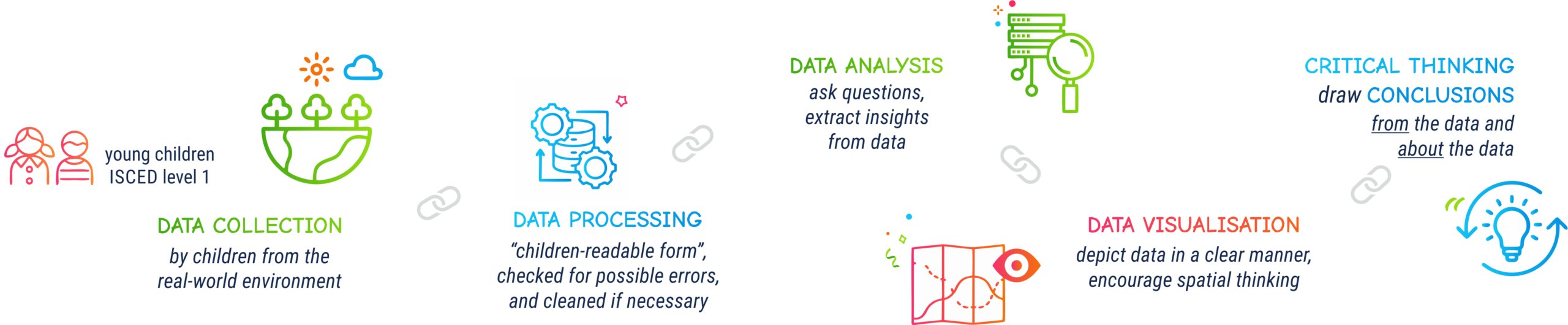
Each workshop consists of two sessions. Workshop and sessions topics are as follows:
- Workshop 1: Data in Our Hands (and Mobile Devices)
Session 1: Mobile Device Usage Data
Session 2: Collecting and Analysing Mobile Device Usage Data
Pupils explore real-life data using their own mobile device habits. They estimate and record their app use, learn to group and visualise data, and then collect and analyse real data to compare estimates with actual results. Through these activities, they discover the importance of accuracy, privacy, and critical thinking when working with data.
- Workshop 2: Geospatial Data (and Maps) in Our Hands
Session 1: Smart Maps in Action: Trace, Overlay, and Discover!
Session 2: Escape (class)room! Spatial Data Analysis
Pupils are introduced to geospatial data and the basics of Geographic Information Systems (GIS). They first create map layers on transparent sheets to model how GIS organises spatial data, then apply this knowledge in a digital detective-style treasure hunt using spatial analysis and real geographic coordinates
- Workshop 3: Data Sources
Session 1: From Our Bodies to Sensor Technologies
Session 2: Technology to the Rescue! Or not?
Pupils obtain advanced data skills by collecting and comparing data from various real-world sources. Using examples like counting steps and measuring/calculating distances with different tools and apps, they learn to assess data quality and analyse discrepancies. The activities highlight the importance of verifying technological results rather than relying on them blindly.
Workshops – implementation
To pilot and later fine-tune our approach, we implemented our workshops in several schools in Croatia and the Netherlands:
- Primary school Ante Kovačića, Marija Gorica, Croatia – school grades 2, 3 and 4
- Primary school Vrbani, Zagreb, Croatia – school grades 2,3 and 4
- Primary school De Triangel, Delfgauw, Netherlands, group 7A and 7B
- Primary school De Keizerskroon, Pijnacker, Netherlands, group 8A, 8B and 8C
Our workshop implementation was done in two cycles. After each workshop, we performed evaluation activities with pupils and teachers, who graded our approach with high grades. Nevertheless, after the first cycle, we performed our internal evaluation where we discussed the lessons learned from both sites and compared the implementation in different settings in different countries.
Based on the lessons learned and evaluation results, in the second cycle we improved our approach and workshop activities and implemented workshops again, in new schools and new educational settings. After the second cycle, we performed a new round of external and internal evaluations and finally fine-tuned our activities and resources.
Altogether, 225 pupils (114 from Croatia and 111 from the Netherlands) were involved, together with 12 teachers (6 from Croatia and 6 from the Netherlands) in our workshops.
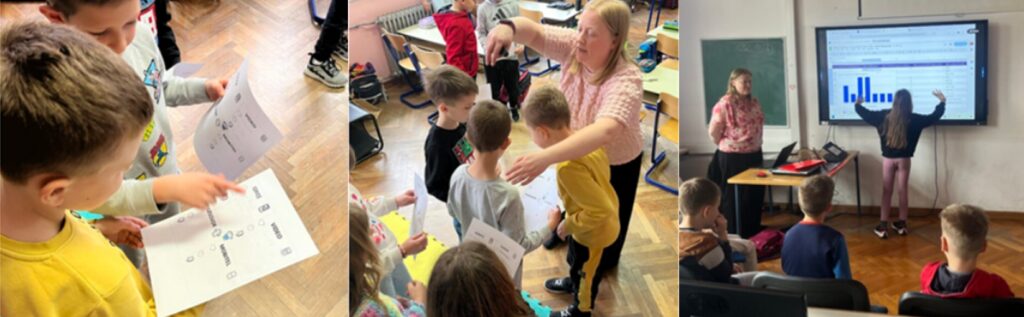
Workshop 1: Data in Our Hands (and Mobile Devices) introduces basic data skills.

Workshop 2: Geospatial Data (and Maps) in Our Hands introduces moderate data skills.
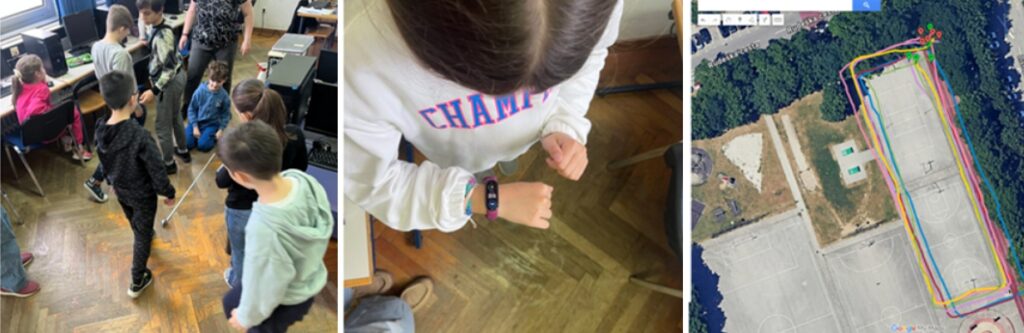
Workshop 3: Data Sources introduces advanced data skills.
Open educational resources
The goal of the project was not only to teach “some” pupils about the data literacy, but to have a wider reach by providing all methods and activities as open educational resources, which teachers could implement on their own, either by simply (re)using our materials, or by revising and remixing them, taking only what they need, or widening some of the activities they are especially interested in.
Our workshop resources include:
- lesson plan (organisation, learning outcomes, discussion questions, step-by-step activity discussions, …)
- presentation (slides ready to be used during the activity)
- templates (separate files needed for activity implementation)
- detailed instructions for activity preparation, including tutorials for less known tools.
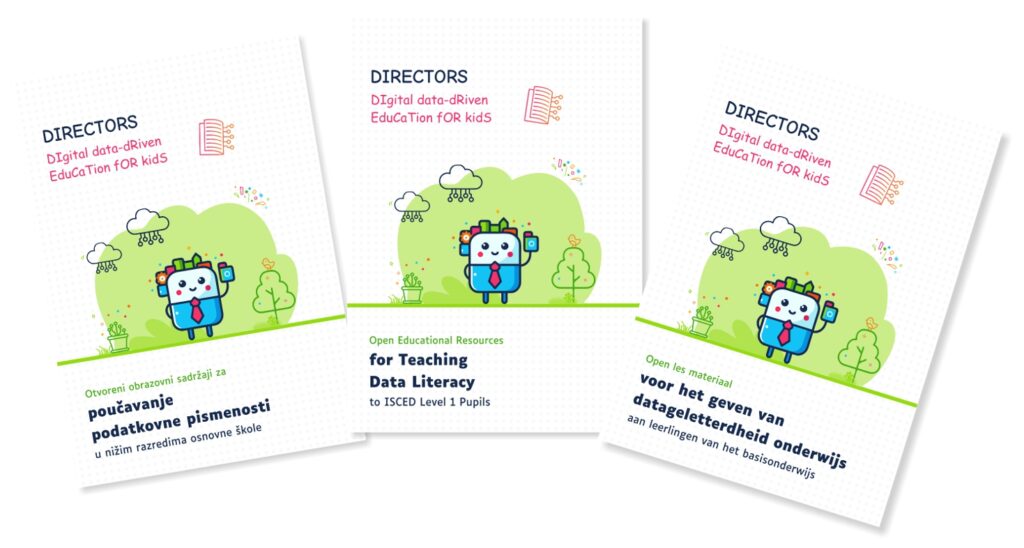
Developed resources are:
- Complete – the materials are designed so that they can be downloaded and fully implemented using the provided resources, without any special adaptation.
- Adaptable – being aware of the diversity of educational contexts, our developed adaptable resources include numerous options and ideas for adjusting activities to pupils’ age, available time, materials, and context.
- Open – all materials are published under the Creative Commons BY 4.0 licence, which allows free sharing and remixing, provided the authors are credited. It is important to note that all resources are published in multiple formats: in addition to PDFs suitable for printing, all documents are available in editable formats (.DOCX, .PPTX); all templates can be modified, etc.
- Accessible – the resources are prepared in a way that enables as many people as possible to use them, including individuals with certain types of disabilities. The best example is the design of Workshop 2 on Geographic Information Systems, which was adapted (and experimentally delivered!) for visually impaired children.
Our impact on teachers
Besides just providing teachers with lots of resources, we realized that teachers need support in their own preparation and implementations. We put different efforts to showcase and explain our approach and resources in different teacher-related events:
- Seminar on data literacy and data teaching methods – held in Zagreb, Croatia in May 2025, after both workshops cycles, this seminar gathered 175 educational staff members (mostly teachers in primary in secondary schools) who learned about the details of our workshops during an intensive 90-minute session. In addition, this was the opportunity to conduct a data literacy survey with participants, to collect their opinions on the current level of data literacy in primary schools and their attitudes towards this topic. The survey results showed a great need for such resources and methods for teaching data literacy.
The seminar was organised in collaboration with the science-popularisation programme of the Faculty of Electrical Engineering and Computing, ŠUZA – From School to Science and the Academic Community, which regularly brings together teachers and provides them with practical suggestions for integrating new technologies into their teaching.
In addition, the Education and Teacher Training Agency – the central national institution responsible for supporting, training, and professionally advancing teachers in Croatia – included the seminar in the Catalogue of Professional Development Events for 2025. This recognition further highlights the seminar’s relevance and value for teachers’ ongoing professional development. - Four workshops on the 4th STEM Teachers’ Meeting – held in Zagreb, Croatia as a part of the event organised by Faculty of Electrical Engineering and Computing. It gathered more than 250 teachers, professors, and principals from primary and secondary schools across Croatia. Our workshops were derived directly from our project resources, showing participants at the same time how to use our educational methods, and teaching them something new in STEM. The workshops were titled:
- Data sources: how much can we trust technology?
- How to introduce spatial data to pupils? GIS through layers and play
Each workshop was performed twice, to provide more participation opportunities.

- Curriculum guidelines – to help teachers put our workshops in the wider educational context, we created a Curriculum guidelines document, which connects our workshops with the educational processes. The most attention was put on mapping workshop learning outcomes to the educational learning outcomes of other courses. Also, the document describes other ways of including the workshops in educational settings (cross-curricular themes, etc), using the activities in the courses not primary developed for, or adapting the approach for older pupils based on the very positive feedback we received. The Curriculum guidelines document considers both Croatian and Dutch educational contexts and focuses on the specifics of each country.
Our impact on wider community
The impact on the wider community goes in three directions: academic, professional, and popular.
Academic impact:
- MIPRO 2025 convention – we published and presented two scientific papers in the the “Computers in Education” and “Engineering Education” MIPRO convention, held in June 2025 in Opatija, Croatia. The papers focus on lessons learned and connect our approach to early education of future engineers. The paper titles are:
- Promoting Digital Data Literacy in Primary Education: First Lessons from the DIRECTORS Project
- Integrating Engineering Principles in Data Literacy Workshops for Primary Education
Professional impact:
- GeoAI – Geoinformation and Artificial Intelligence – we presented our educational approach with the focus on geoinformation data literacy at the professional conference held in July 2025, organized by Croatian Cartographic Society and Faculty of Geodesy, attended by around 80 participants. The presentation was titled “GeoAI in Primary Education”.
- We shared our results with the geo-information education community in the Geo-onderwijsdag organized at TU Delft, Netherlands in June 2025 and attended by approximately 35 people.
- Our work is also published in the paper “Slimme kaarten op de basisschool; Ervaringen uit het DIRECTORS-project” in the Dutch Geografie journal.
- We also started a cooperation with EduGIS to make workshop 2 location independent so that all Dutch schools can easily implement workshop 2. The work is performed by the teacher students of the Hogeschool Stenden in Leeuwarden.
- Teaching geo-data science in primary schools will be part of the priorities in the Dutch vision for geo-information 2026-2031 (Geosamen 3/ Partners in Geo 3).
- Pogled kroz prozor (A view through the window) – a professional article titled “Data literacy: open educational resources” submitted to the web journal for teachers of Croatia
Popular impact:
- Festival of Science Zagreb – to bring closer data literacy to wider audience, we participated in the public festival focused on bringing science activities to the public, held in May 2025 in Zagreb. Designed as short workshops (each 10 minutes over 2-hour period), we introduced data literacy to around 30 participants.
What to say in the end?
As we wrap up the DIRECTORS project, one thing has become very clear to all of us: data literacy is not a distant skill for experts – it is something children can understand, enjoy, and use in their everyday lives. As university teachers, we strongly believe that data literacy matters not only for adults but also for children, and this project showed that it can be successfully taught even to very young pupils aged 8 to 10.
Over the past two years, we designed, tested, revised, and refined workshops that truly work in real classrooms. We saw curiosity, creativity, teamwork, critical thinking, and problem-solving – and above all, we saw that young learners want to make sense of the data-filled world around them when given the right tools and guidance.
Our work was guided by a single goal: helping teachers provide high-quality data literacy education. The project was never only about producing materials, but about building confidence – for teachers to try something new, and for pupils to explore, question, and analyse.
We hope the open, adaptable resources we created will continue to live far beyond this project: in classrooms, workshops, cross-curricular activities, teacher trainings, and in new ideas sparked by those who adapt and build upon them.
Finally, we express our sincere thanks to all pupils, teachers, and schools in Croatia and the Netherlands who opened their classrooms to us, challenged us, and helped us shape something better than we first imagined.
To all educators who continue using, adapting, and remaking our materials – thank you for carrying this work forward. We wish you and your pupils all the best in your future learning experiences.